
How Long Can You Actually Live With a Broken Tooth? A Dentist’s Honest Timeline
“Doctor, I broke this tooth last year. It stopped hurting, so I just left it.”
In my chair at Boateng Dental, I hear some version of that sentence every week. Sometimes the tooth broke on a piece of roasted corn. Sometimes it was a chicken bone, or a fall, or a tooth that simply gave way after years of quiet decay.
The reasons for waiting are always real: money is tight, work is busy, or the dental chair feels frightening. I never judge anyone for that. But I do want you to know what is happening inside that tooth while you wait, because the answer to “how long can I live with it?” is not a fixed number of days. It depends on what kind of break you have and what is going on beneath the surface.
QUICK GUIDE
You can live with it, but the tooth keeps changing: many people go months with a broken tooth, yet bacteria, cracks, and decay keep working the whole time.
- Pain is a poor guide: a broken tooth that stops hurting may have a dying nerve, which can lead to a silent infection at the root.
- Earlier is cheaper and simpler: a break fixed in the first few weeks often needs bonding or a filling; months later it may need a root canal, a crown, or an extraction.
- Dentist-approved stopgap: a temporary dental filling/repair kit can cover a sharp or sensitive edge while you arrange your appointment.
What Is Actually Happening Inside a Broken Tooth
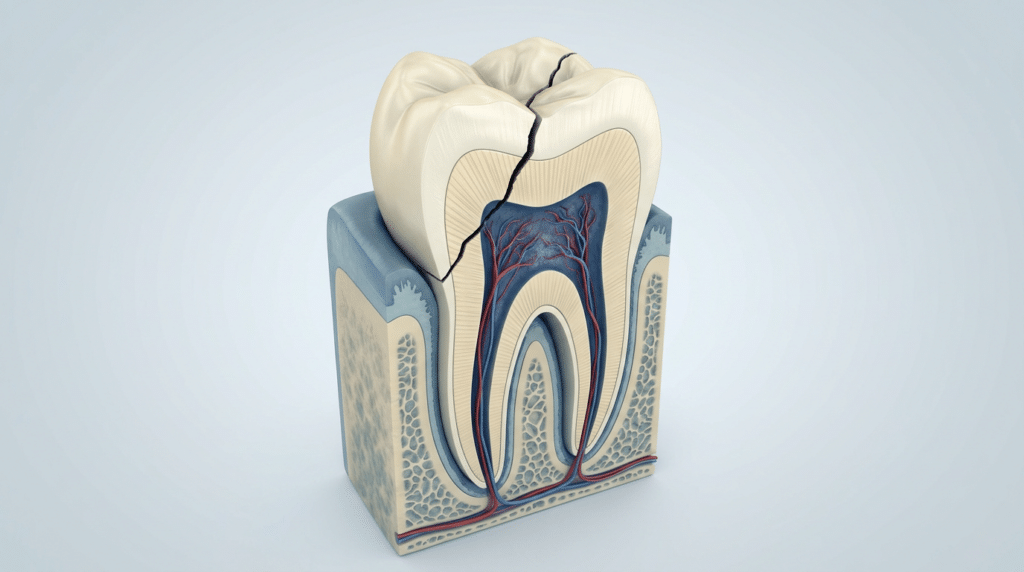
To understand the timeline, picture a tooth in three layers.
Enamel: the protective shield
Enamel is the hard outer shell. Think of it as the tooth’s shield. It has no nerves, so a small chip in enamel alone may not hurt at all.
Dentin: the sensitive middle
Under the enamel is dentin, a softer layer full of tiny tubes that lead towards the nerve. When a break exposes dentin, you may feel sensitivity to cold water, sweet drinks, or air.
Dentin is also softer than enamel, so bacteria and decay move through it faster once the shield is gone.
Pulp: the living core
At the center is the pulp, the soft tissue holding the tooth’s nerve and blood supply. If a break reaches the pulp, or bacteria travel there through the dentin, the pulp becomes inflamed. Dentists call this pulpitis (inflammation of the pulp).
If that inflammation continues, the pulp can die. This is called pulp necrosis. A dead pulp can then become infected, forming an abscess (a pocket of infection) at the tip of the root.
The Broken Tooth Timeline: Days, Weeks, Months, Years
Every tooth is different, so treat this as a general guide, not a promise. A deep break reaching the nerve can move through these stages much faster than a small chip.
The first few days
- Sharp edges may cut your tongue or cheek.
- Sensitivity to cold, heat, or sugar is common if dentin is exposed.
- A “fresh” break is usually the easiest to repair.
For a small break, this is often the window where a quick composite bonding (tooth-colored filling material) is all you need.
Weeks two to six
- Food and bacteria settle into the rough, broken surface.
- Decay can start in the exposed dentin, sometimes hidden under the edge of the break.
- A cracked tooth may flex every time you chew, slowly lengthening the crack.
Many people feel their teeth “settle down” during this stage. Often that is just the nerve adapting, not the tooth healing. Teeth do not grow back enamel or dentin once it is lost.
Months two to six
- If bacteria reach the pulp, the nerve may become inflamed and then die.
- You may notice the tooth turning darker, grey, or yellow.
- Some people feel a dull ache when biting, or a bump on the gum near the tooth.
- Others feel nothing at all.
By now, a simple bonding may no longer be enough. The tooth might need a root canal treatment (cleaning out the infected nerve) and a crown (a cap that covers and protects the whole tooth).
Six months and beyond
- A long-standing infection can slowly wear away the bone around the root.
- The remaining tooth may become weak enough to split, sometimes below the gum line.
- Neighboring teeth can drift into the gap, and the opposite tooth can over-erupt, changing your bite.
At this stage, I sometimes have to tell patients that the tooth cannot be saved. If you want to understand how dentists make that call, read How Broken Is Too Broken to Fix a Tooth?.
Why “It Stopped Hurting” Can Be the Worst Sign
This is the part I most want you to remember. When a broken tooth hurts and then suddenly goes quiet, it is tempting to think the problem has passed. Sometimes it has simply calmed down. But sometimes it means the nerve has died.
A dead nerve no longer sends pain signals, but the space inside the tooth is still there, and bacteria can multiply in it. The infection may grow quietly at the root tip for months before it flares up with swelling, often at the worst possible time.
So I always say, “No pain does not mean no problem.” A quick check and an X-ray are the only reliable way to know what is happening inside.
What Speeds Up the Clock
Some things make a broken tooth deteriorate faster. If any of these apply to you, I would encourage you not to wait.
The type and depth of the break
- A small enamel chip on a front tooth may stay stable for a long time.
- A large break on a back molar, where chewing forces are strongest, tends to worsen faster.
- A break where you can see a pink or red dot in the center may mean the pulp is exposed. That needs prompt attention.
If a large piece has come away, my article on what happens if half your tooth breaks off explains your immediate options.
What and how you eat
Here in Ghana, many of our favorite foods are hard on teeth. Roasted corn, groundnuts, chewing on bones, cracking ice, or crunching hard-fried snacks all put heavy force on a weakened tooth.
Frequent sugary drinks, sweetened tea, and sweets also feed the bacteria that cause decay in the exposed dentin.
Grinding and clenching
Bruxism (grinding or clenching your teeth, often at night) puts huge repeated pressure on a cracked tooth. If you wake with a sore jaw or your partner hears you grinding, a night guard can help protect the tooth until it is repaired.
A shop-bought guard is a temporary measure. A dentist-made guard fits better and is the long-term option.
Dry mouth and heat
Saliva is the mouth’s natural rinse and repair system. In hot weather, or if you don’t drink enough water during a long working day, your mouth can become dry. Less saliva means faster decay on an exposed surface. Keep water with you and sip regularly.
Beyond the Tooth: Why a Long Wait Can Affect Your Health
Most broken teeth never cause serious illness. But a long-standing infection is not something to ignore. An untreated dental abscess can spread into the surrounding bone, the face, or the neck. In rare cases, this becomes a medical emergency. That is why the red flags below matter so much.
A broken tooth can also affect daily life in quieter ways: chewing only on one side, avoiding certain foods, or hiding your smile at work.
Red Flags: See a Dentist Urgently If…
Please don’t wait for your next “convenient” moment if you notice any of these:
- Swelling of your gum, cheek, jaw, or under your chin
- Fever or feeling generally unwell alongside tooth pain
- Pain that spreads to your ear, eye, or neck, or wakes you at night
- A bad taste or pus draining near the tooth
- Difficulty swallowing, breathing, or opening your mouth (go to a hospital emergency department immediately)
- A recent knock or fall that broke the tooth, especially if a tooth feels loose
At Boateng Dental, we keep time for urgent cases.
The Cost of Waiting: How Treatment Changes Over Time
I understand that cost is often the real reason people wait. So let me be practical. In general, treatment moves up a “ladder” the longer a break is left:
- Polishing or bonding for a small chip: usually the quickest and least expensive option.
- A larger filling or onlay if more teeth are missing but the nerve is healthy.
- A crown when the tooth needs full coverage to stop it splitting.
- Root canal treatment plus a crown if the nerve has become infected or died.
- Extraction and replacement (implant, bridge, or partial denture) if the tooth can no longer be saved.
Each step up usually means more appointments and a higher cost. Prices vary by clinic and by how complex the tooth is, so the best way to plan is to get an exam and a written estimate. Many patients are relieved to find that acting early keeps them on the lower rungs.
If budget is your main concern, ask us about phasing treatment, starting with the most urgent tooth first.
How to Protect Your Tooth While You Arrange Treatment
These steps don’t fix a broken tooth, but they can slow damage and keep you comfortable for a short time.
Keep the area very clean.
Brush twice a day gently with a soft-bristled or pressure-sensor electric toothbrush, which cleans well without scrubbing at the broken edge.
Use a fluoride toothpaste to help strengthen the exposed surfaces. If your dentist recommends it, a higher-fluoride toothpaste can offer extra protection. Clean between the teeth gently
Food often packs into the gap next to a broken tooth. Interdental brushes in the right size, or a water flosser on a low setting, can clear it without snagging.
Calm sensitivity
A desensitizing toothpaste (look for potassium nitrate or stannous fluoride on the label) can ease cold sensitivity over a couple of weeks.
Rinsing with an alcohol-free fluoride or CPC mouthwash can help reduce bacteria without stinging.
Cover sharp edges
Orthodontic wax pressed over a jagged edge protects your tongue and cheek.
A temporary filling kit can do the same job for a slightly larger break. Remember, these are for days, not months.
Chew smart
Chew on the other side, choose softer foods, and avoid hard, sticky, or very cold items until the tooth is repaired.
“A broken tooth rarely stays the same size. In my experience, a chip fixed in the first few weeks is often a simple bonding, while the same tooth left for months can need a root canal and crown, or come out. And when a broken tooth stops hurting, the nerve may have died, so silence is a reason to get checked, not a reason to relax.” Dr. Frimpong, Practising Dentist, Boateng Dental, Accra
If Fear Is What’s Keeping You Away
Many of my patients waited because the last dental visit they had was painful or embarrassing. That fear is real, and it is common.
At Boateng Dental, we explain everything before we start, agree on a signal you can use to pause, and never lecture you about how long you’ve waited. You are not the first, and you won’t be the last.
Your Next Steps
- Look at the tooth in good light and note any dark colour, gum bump, or swelling.
- Protect it: clean gently, cover sharp edges, chew on the other side.
- Book an exam with X-rays so you know exactly what stage the tooth is at
- Ask for a written plan with options at different price points.
- If any red flag appears, seek care the same day.
Frequently Asked Questions
Conclusion: You Don’t Have to Keep Living With It
You can live with a broken tooth for a while, and many people do. But every week, that tooth is quietly changing, and the longer it waits, the more involved the repair usually becomes.
The good news is that you don’t have to fix everything at once. A single exam can tell you exactly where you stand, which tooth matters most, and what a sensible step-by-step plan looks like.
Want tips like these delivered straight to your inbox? Get our free Fresher, Brighter Smile in 7 Days guide and subscribe to the Boateng Dental Newsletter for exclusive product deals, early access to our full dental guides, and seasonal tips you won’t find on the blog.
While you wait for your appointment, the dentist-approved products above (a temporary filling kit, orthodontic wax, a soft or pressure-sensor toothbrush and a desensitising toothpaste) can keep you comfortable for a short time.
And when you’re ready, we’re here. Book a calm, no-lecture visit at Boateng Dental.
About the author: Dr. Frimpong, Practising Dentist, Boateng Dental, Accra. Dr. Frimpong treats patients of all ages at Boateng Dental and writes these guides to help people make calm, informed decisions about their teeth.
Disclosures: As an Amazon Associate, Boateng Dental earns from qualifying purchases. This article is for educational purposes only and is not a substitute for an in-person dental examination, diagnosis, or treatment.